Your strategy,
to win this home
650+ views, 67 saves in 24h viewings
No bids yet
All with better energy label
All sold for less
How Dutch bidding works
Buying a home in the Netherlands is different from most other markets. The process has its own rules, terminology, and expectations. Before you read our analysis and strategy, take five minutes for this primer. It will make every decision in this report easier to understand.
In the Netherlands, the vraagprijs (asking price) is not a fixed price. It is an invitation to make an offer. The seller can accept, reject, or counter. There is no public auction: bids are private, usually submitted in one or two rounds via the seller's agent.
In hot markets buyers often bid above asking, sometimes with no contingencies. In cooler markets or on properties that have lingered, there is room to negotiate below asking. Knowing which situation you are in is half the battle. This report tells you exactly that for Kinderdijkstraat 84-2.
Asking price. An invitation to bid, not a fixed price. In a cool market buyers bid below, in a hot market above.
Buyer's costs. Roughly 4% on top of the purchase price: transfer tax, notary, registration. Listings show “k.k.” meaning these costs are on top.
Dissolving conditions, similar to contingencies in the US. Common: financing (finance clause), structural survey (bouwkundige keuring). If triggered, you can walk without penalty.
The purchase agreement you sign after your bid is accepted. This is where most risk lives. We review it line by line before you sign.
Civil-law notary. Handles the deed of transfer and registration. Independent of either party. Not an attorney: no legal advice on the contract itself.
Deposit or bank guarantee, standard 10% of the purchase price. Due a few weeks after signing, held by the notary. Forfeited if you back out without a valid contingency.
Municipal property value, used mainly for local tax. Reasonably reliable in the mainstream segment (€250K to €600K); above €600K it structurally understates market value. We treat it as one data point, never as the basis of our advice.
Every property sale in the Netherlands is officially registered. Our comparables in Section 04 come from professional transaction data, including sales that never appeared on public listings.
Estate agent. The seller's agent (verkopend makelaar) works for the seller. A buying agent (aankoopmakelaar) works for you. Aestimo is neither: we are an independent bidding strategist.
Statutory 3-day cooling-off period after you sign the purchase agreement. You can cancel within three calendar days, no reason needed, no penalty.
Via the seller's agent, in writing, with conditions. The bid letter (Section 08) matters.
Accept, reject, or counter. Usually within a few days. Sam coaches you through counters.
Purchase agreement drafted. We review it. You sign. 3-day cooling-off starts.
Usually 4 to 6 weeks to arrange financing and any surveys. 10% deposit at the notary.
At the notary. Deed signed, funds transferred, keys handed over. The home is yours.
No escrow, no title insurance, no attorney by default. The notary handles closing but doesn't negotiate. The purchase agreement binds you before financing is confirmed, which is why the financieringsvoorbehoud (financing contingency) matters.
No conveyancing solicitor in the standard process. No separate exchange and completion: one purchase agreement, with the 3-day cooling-off and contingencies as your safety net. Gazumping is rare because accepted offers are usually binding within days.
We are your bidding strategist, not your agent. We do not attend viewings on your behalf or negotiate directly with the seller, you stay in control of every conversation. What we do: turn market data and your personal situation into a clear bid strategy, write the bid letter in Dutch or English (whichever the seller's agent prefers), review the purchase agreement, and stay reachable by WhatsApp from the first bid to the notary appointment.
If you are currently abroad: everything we do works over WhatsApp, email, and video. You do not need to be in the Netherlands to get a strategy, submit a bid, or sign a purchase agreement (digital signing is standard now). Sam responds same-day across CET business hours, if you are in a different timezone, we schedule calls that work for you.
One moment of physical presence is typical: the notary appointment for the deed of transfer. If you cannot be there, a volmacht (power of attorney) lets the notary sign on your behalf, common for international buyers, arranged at your nearest Dutch embassy or consulate.
This report uses the English convention: €485,000. Funda, Dutch banks, and industry sources use: €485.000.
Same number, different separators. When you negotiate or sign, the Dutch notation will appear, do not let a misplaced comma or full stop throw you off.
Mark & Lisa, here is the core of our analysis
“The asking price is ambitious. You are in a strong negotiating position. Use it.”
Listed today on Funda, 650+ views, 67 saves viewings, one bid, yours. No need to overpay.
Three comparables, same year built, all with better energy label, all below this asking price.
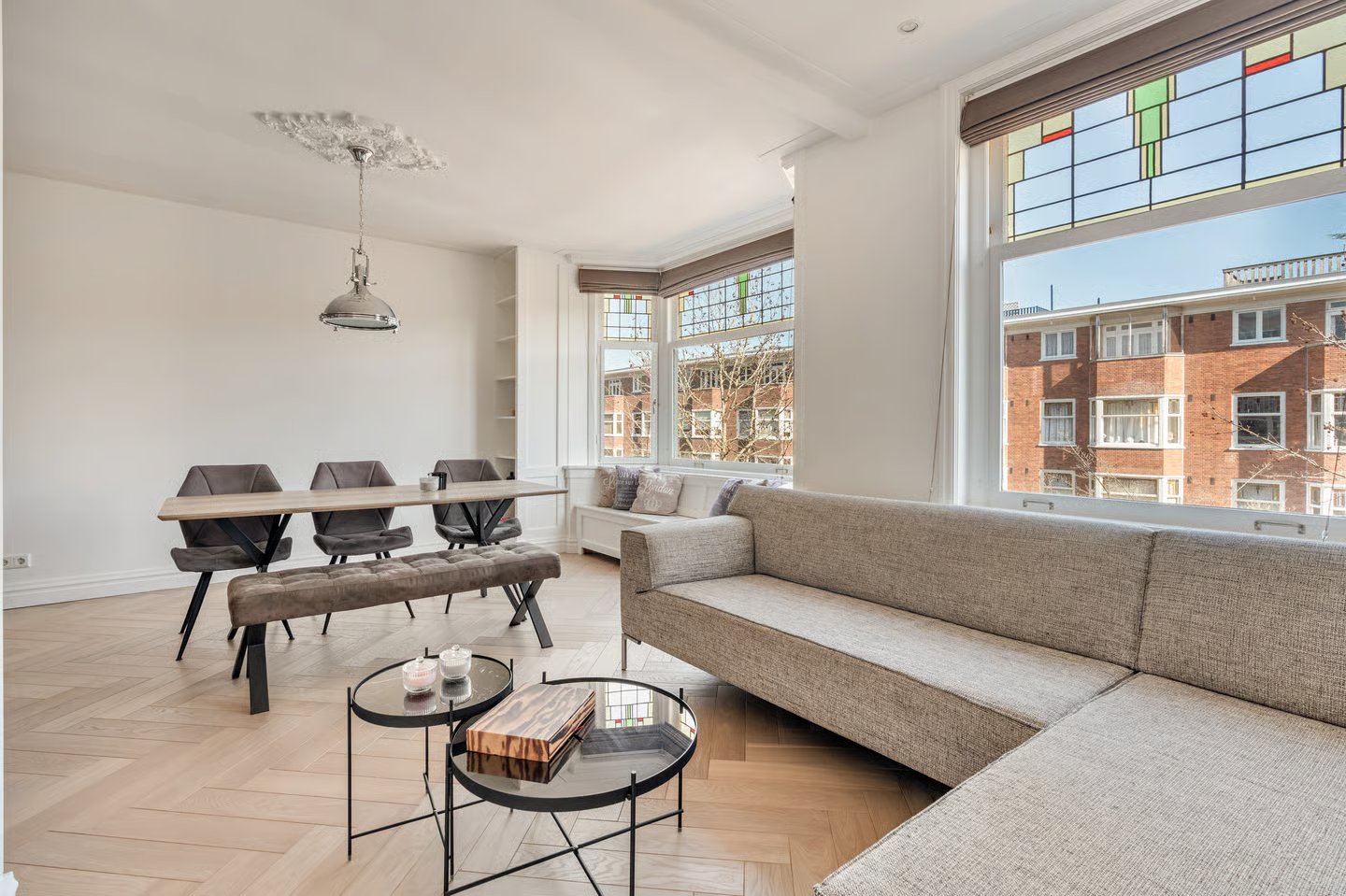
A quiet west-facing balcony in a 56m² city apartment is a serious plus. In a search filter this scores higher than a larger apartment without outdoor space, driving viewing interest even further up.
Profile & value history
Rijnbuurt-Midden, Amsterdam in numbers
Rijnbuurt-Midden is a desirable neighbourhood in Amsterdam-Zuid. We have filtered the market data for comparable property type and construction year, so the context is accurate for Kinderdijkstraat 84-2.
Listed on Funda since 29 April 2026 (Listed today). The limited interest confirms the asking price is too high.
Three comparable transactions
From 30 comparables (professional transaction data, including sales that never appeared on public listings). Filtered by year built 1937, comparable type, neighbourhood Rijnbuurt-Midden. Each property has a "Compare to Kinderdijkstraat 84-2" button to see differences side by side.
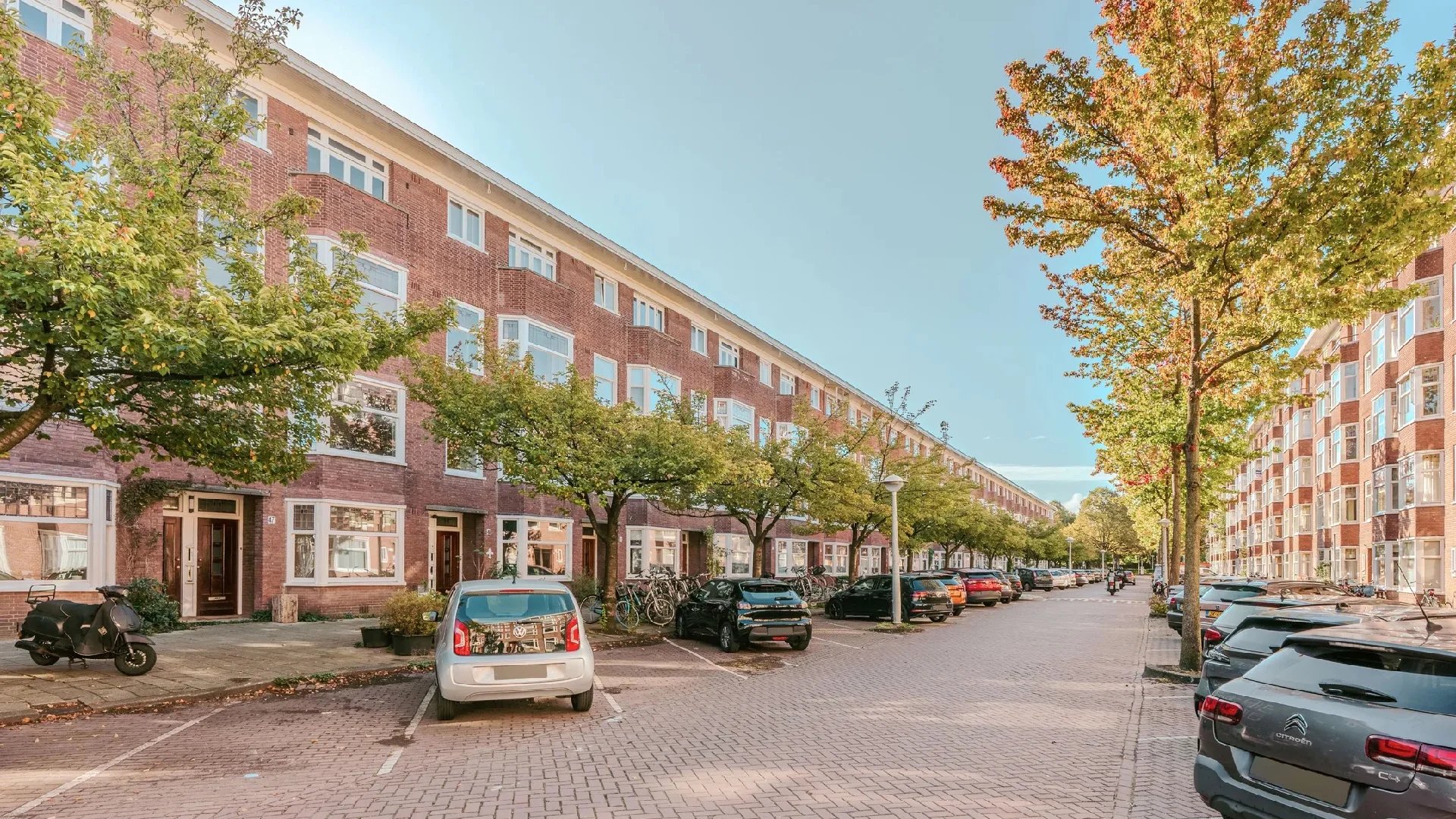
Just 350m from the subject. Comparable construction period, comparable original details, marginally larger (60 vs 56 m²). The €530,000 sale price at 60m² gives a benchmark of €8,833/m² for well-maintained 1930s apartments in this area.
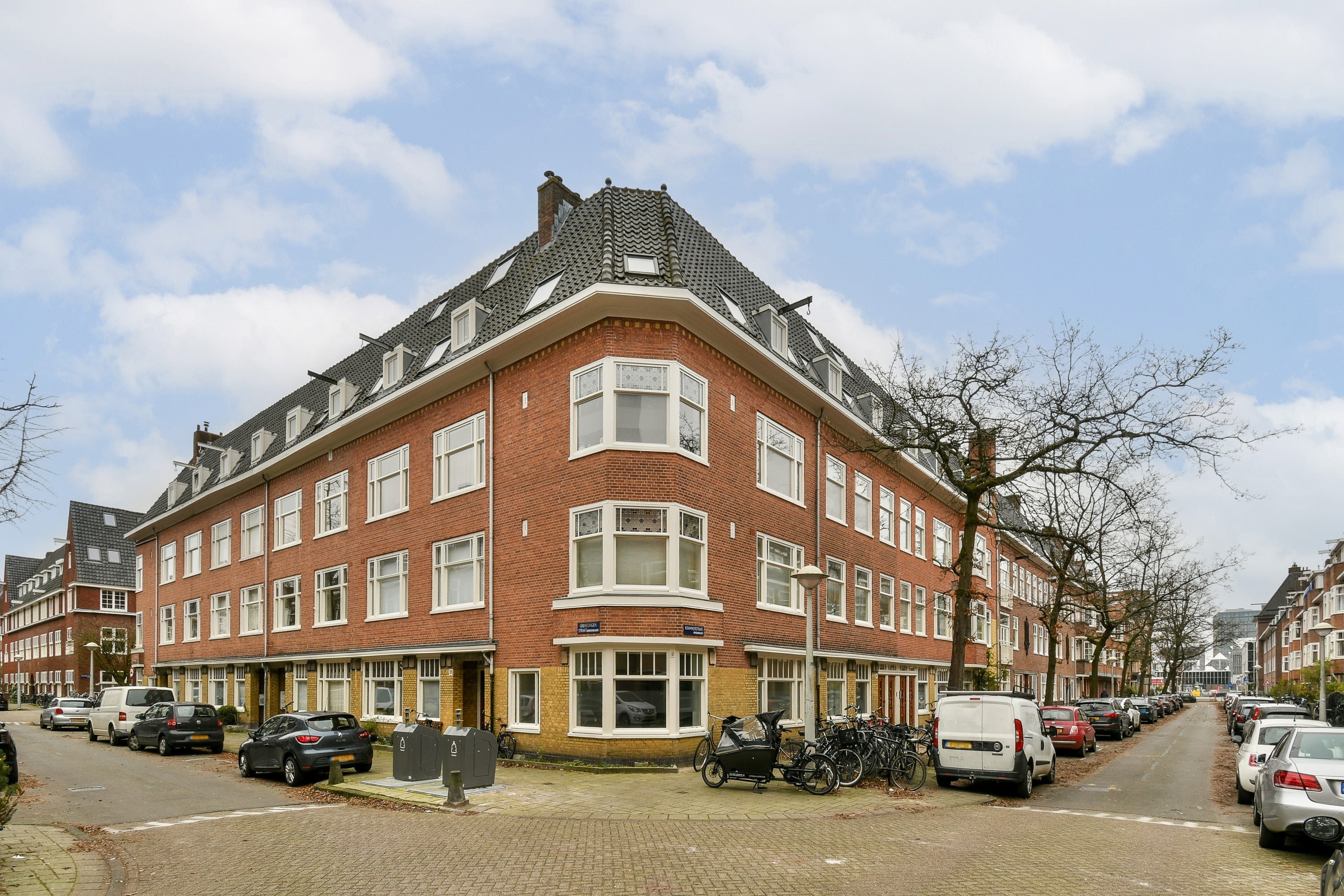
Almost identical in size (55 vs 56 m²) and construction period. Sold 6 months ago at €495,000, that is €9,000/m². The recent modernisation explains the higher €/m² compared to Vechtstraat 47-2.
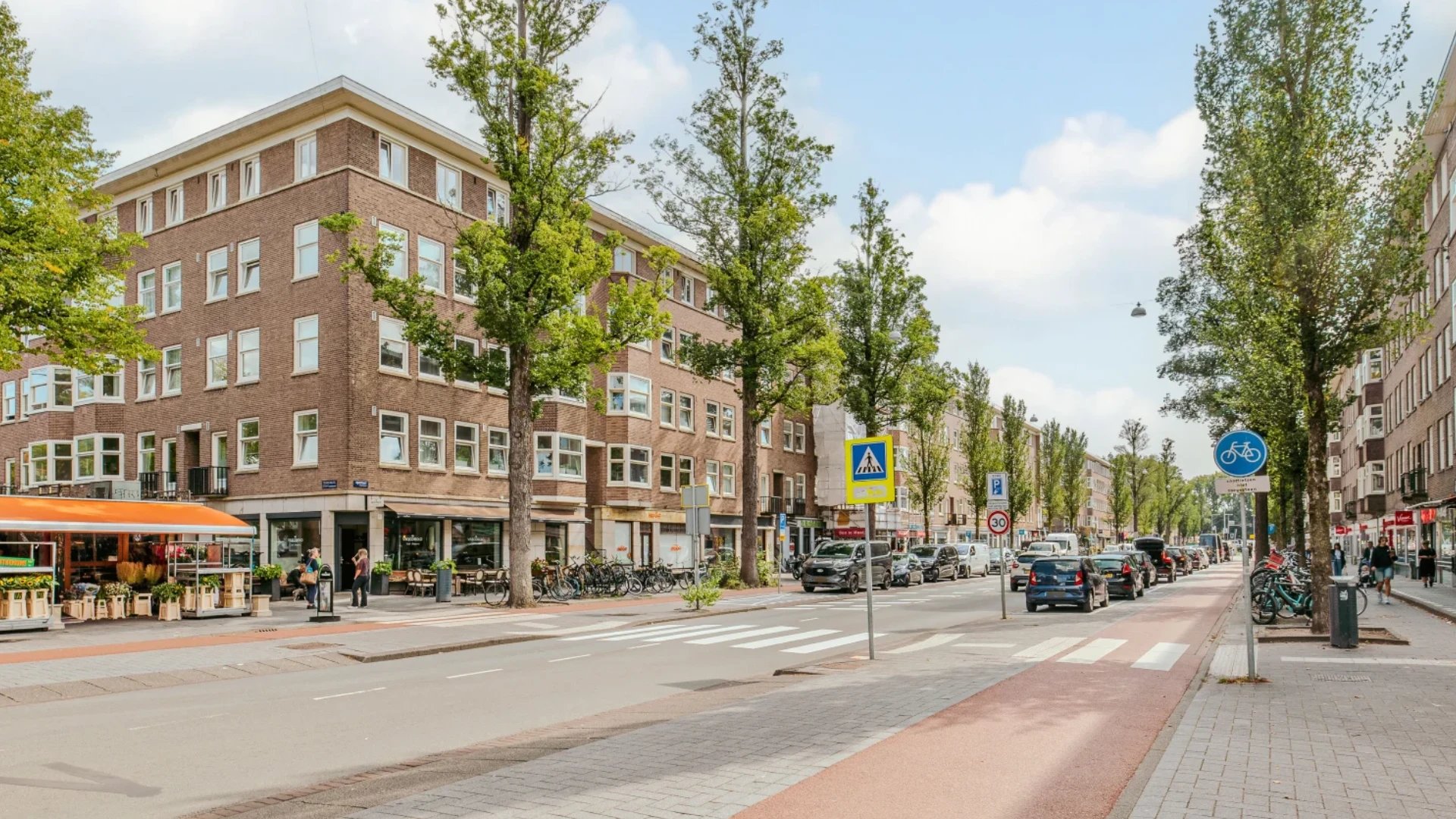
Substantially larger (65 vs 56 m²). Sold 3 months ago for €555,000 at 65m² gives €8,538/m², slightly under Vechtstraat 47-2, which is consistent: larger units typically score slightly lower €/m².
All comparables with the same year built and a better energy label support a lower valuation.
What is the other side thinking?
Based on market behaviour, comparable sales processes, and this property's position on Funda.
Negotiation room above asking price, minimum €510K, possibly higher.
Speed and certainty. Non-occupancy clause suggests vacant home with running costs.
No alternative, once the sealed-bid round closes, there must be a serious offer or the process restarts.
Dutch sellers and their agents are not openly suspicious of international buyers, but they do calculate silently: "the expat mortgage could fall through", "they might relocate before transfer", "less familiarity with the Dutch process means slower closing". If we do not actively counter that, an equal bid from a Dutch couple can win ahead of yours. Four concrete moves shift the perception:
Obtain a mortgage pre-approval (also called offerte-indicatie) from a Dutch bank or broker before bidding. Attach the amount to your bid letter. Signals: financing is lined up, closing risk is low.
Offer a bankgarantie (bank guarantee) instead of a cash waarborgsom (deposit). Same legal effect for the seller, but signals that a bank has vouched for you. Most Dutch banks issue these in 1 to 2 weeks for around €200 to 300.
In the bid letter, briefly name your employer and contract type (permanent or long-term). If you already live in NL, say so. If you are relocating: state your intention to settle here for the long term. Sellers prefer certainty about who takes over the home.
Offer a completion date that works for the seller and is achievable for your mortgage process (typically 8 to 12 weeks from agreement). Do not undershoot to look fast, if you miss the date it weakens your position and the seller's trust.
What stands out about this property
You described the location as “Authentic charm, fireplace, stained glass, ceiling ornaments” and the house as “West-facing balcony on quiet inner garden”. Single-level living, garage, insulated, sunny garden.
Location is strong. It's the condition that does not justify the price.
“Really quite dated.” Not foreseen lowers the effective value.
Score 8/10/10 + alternative option. No emotion, no rush. That's your position.
This is a beautiful apartment in a neighbourhood where this type is becoming scarce. But €512,500 is a deliberately tight limit. I would place the bid right here, and if someone bids €515K or more: let it go. That is not a loss, that is staying rational within your limits. The next opportunity will come, Rijnbuurt-Midden produces a comparable home four to six times per year.
Mark & Lisa, here is the plan
Based on our analysis, your intake, and how comparable negotiations play out in this neighbourhood.
The market is not responding to €475,000. After fresh on the market the seller feels the pressure building. That means room to negotiate.
€37,500 above asking price, within market value range. Competitive and disciplined, strategically not rounded.
Click a zone to see what that bid means for you.
Strong signal. Room for counter.
Just below market value mid. Real winning chance.
Only if seller does not move.
Our recommendation. Just below market value mid €517,500. Real chance of winning, with €7,500 buffer to your absolute maximum as an emotion check.
“Are there other bids?” Expect: no.
No financing contingency (subject to dossier confirmation). Short term from acceptance to transfer: 6 weeks.
Do not call yourself.
Click the scenario that happens to you to see the follow-up steps.
Someone bids slightly higher
Hold firm. Be ready to walk.
Message Sam. Book the survey.
Wait a week. They come back.
Concrete phrases for the conversation. Click "Copy" to send a script to your clipboard, then paste it into an email or note. Each script has an English version for your reference and a Dutch version underneath, most estate agents in urban areas speak fluent English, but you can also send the Dutch version in writing if preferred.
“We are bidding €512,500, based on recent transactions. Flexible completion, no financing contingency.”
NL: “Wij bieden €512,500, gebaseerd op recente transacties. Flexibele oplevering, geen financieringsvoorbehoud.”
“Our analysis is based on three recent comparable transactions in the immediate area and the market value range that follows. We have a firm purchase limit and we stay within it.”
NL: “Ons bod is gebaseerd op de marktwaarde. We hebben ook andere woningen in beeld.”
“We value the property, but we cannot raise our bid. Our limit is our limit, not on principle but out of due diligence. If the seller still accepts our offer, we stand ready.”
NL: “Wij waarderen de woning, maar kunnen ons bod niet verhogen. Onze grens is de grens, niet uit principe maar uit zorgvuldigheid. Mocht de verkoper alsnog ons bod accepteren, dan staan wij klaar.”
These scripts are for the business conversation with the estate agent. A bid letter (Section 08) speaks to the seller personally. Who you are, why this home fits, and that you are financially serious and prepared.
At a bid of €512,500 on an asking price of €475,000, a potential shortfall arises if the appraiser values lower. Our analysis based on three comparable transactions suggests an appraisal between €505K and €540K is realistic, but the final valuation lies with the appraiser. Own funds needed to cover any gap: up to €7,500 in worst case.
No financing contingency is being considered, subject to dossier confirmation, as competitive advantage in the sealed bids. Always include: building inspection contingency (5 working days, non-occupancy clause makes this extra important).
Your bid, professionally submitted
A bid is more than a number. When offers are comparable, a strong letter can be the tiebreaker, especially with private sellers. We write a bid letter (biedbrief) that persuades the seller, not just financially but on a human level.
No clichés about children in the garden or ‘dreams coming true’. The letter is sincere, concrete, and focused on what you actually see in the home, who you are, and why you are a reliable buyer. The seller should think: this rings true.
We write the letter in the language the seller's agent prefers. Most Dutch sellers are more moved by a letter in Dutch, even if the rest of the process runs in English. We can also provide both versions if that is more comfortable for you.
I write the letter based on what you shared in your intake: what the home means to you, your situation, why this specific house. No template copy. The letter reads as if you wrote it yourself, only sharper and more strategic. You stay in control: you get a draft at least 24 hours before submission, adjust anything that is not right, and only give the green light when it is 100% in your voice.
For Kinderdijkstraat 84-2, the focus is on three personal points that resonate with the seller: (1) you can act fast, no property to sell, no chain, (2) you appreciate the authentic details that make this home unique, (3) you have a serious financial position (€100K own funds, no financing contingency considered). These three points are subtly woven into the bid letter, not as a list, but as a story. The actual letter is delivered separately by Sam, written in Dutch to the selling agent, with an English translation provided to you.
After acceptance, we review the koopakte
Between an accepted bid and the signed purchase agreement (koopovereenkomst or koopakte) there is often only a week. In that week we check the agreement for unfavourable clauses, missing contingencies, and risks that could cost you thousands of euros later. For international buyers this review matters even more: Dutch contracts follow conventions and reference statutes you may not be familiar with.
For this case, I pay extra attention during the purchase contract review to: (1) non-occupancy clause, maintenance condition must be explicitly recorded, (2) leasehold canon €895/year and any buyout offer, terms must check out, (3) building inspection within 5 working days, ensure this contingency is correctly worded, (4) standard clauses on foundations (Amsterdam!) and homeowners' association status.
- Overview of risk points in the proposed agreement
- Guidance on which clauses to have amended
- Concrete negotiation arguments for each point
- Timeline of what needs to happen and when
Within 48 hours of receiving the draft agreement you get our analysis. For urgent cases (signing within three days) we can move faster.
The review runs via WhatsApp or email, whichever you prefer.
Our review is a signalling of potentially unfavourable clauses and risks. It is expressly not legal advice and does not replace review by a lawyer or notary. For complex or large risks we always recommend engaging an attorney as well. For international buyers we can refer you to English-speaking Dutch attorneys if needed.
Your mortgage path in the Netherlands
For international buyers the financing path has specifics that do not appear in a standard Dutch report. This section covers what you need to line up, which steps have hidden deadlines, and where things typically slow down. Nothing here replaces advice from a qualified mortgage adviser, see it as a map so you know what to ask and when.
Required for a mortgage application and the notary. If you are registered in a Dutch municipality, you have one. Non-residents need a BSN-equivalent via an RNI (Registratie Niet-Ingezetenen) appointment.
An offerte-indicatie or haalbaarheidsverklaring from a Dutch bank or broker. States your max borrowing capacity. Takes 1 to 2 weeks. Bid without it and the seller's agent discounts your offer.
Needed for the deposit, mortgage disbursement, and transfer at the notary. If you do not have one, open one early, ABN, ING, Rabobank offer remote-friendly options for expats. Takes 1 to 4 weeks depending on your situation.
Last 3 payslips, employer declaration, employment contract, last tax return. If self-employed: 3 years of financials. Translated if not in Dutch, English, or German.
For international buyers we almost always recommend a hypotheekadviseur (mortgage adviser) over going direct to a bank. A specialist expat broker, such as Expat Mortgages, Hanno, De Hypotheekshop, or ING International, compares lenders, handles the English paperwork, and knows which banks accept your contract type.
Typical cost: €2,500 to 3,500, often partly tax-deductible. Sam can introduce you to brokers we have worked with before.
The 30%-regeling (expat tax ruling) reduces your taxable income, which means your mortgage-eligible income may be lower than your gross salary suggests. Most lenders use gross salary including the ruling, but some do not, this alone can swing your maximum mortgage by €50,000 to 100,000.
If you benefit from the ruling, work with a broker who specifically knows which lenders include it in their calculation.
Permanent contract (vast contract): strongest position, full borrowing capacity. Fixed-term with intention to convert (intentieverklaring): accepted by most lenders if the employer signs a statement. Temporary or freelance: more limited, higher interest, often requires larger down payment. Lenders vary widely, a broker matters most here.
NHG caps at a purchase price of approximately €435,000 in 2026 and requires residency in the Netherlands. If your purchase is above the cap, NHG is not available anyway. Without NHG, interest rates are slightly higher and the bank may require a larger own-funds contribution. For most international buyers in the higher segment, this is simply the reality, not a problem.
Once your bid is accepted and you sign the agreement, your bank will require an NWWI-taxatierapport (an independent, validated valuation report) before releasing the mortgage. This is not our market-value analysis and not the optional bouwkundige keuring (structural survey).
Cost: €500 to 900. Turnaround: 1 to 2 weeks after viewing. Risk: if the valuation comes in below your purchase price, the bank will only lend against the valuation, not the higher price, meaning you may need to bridge the gap with own funds or renegotiate. This is precisely why our bidding range avoids prices significantly above market value.
Sign purchase agreement. 3-day cooling-off (bedenktijd). Instruct your broker to start the full mortgage application.
Book NWWI valuation and (if you chose it) structural survey. Submit income documents. Bank reviews.
Receive mortgage offer. Meet financing-contingency deadline (financieringsvoorbehoud). Arrange bank guarantee or deposit.
Notary prepares the deed. Final inspection. Transfer of ownership at the notary appointment. Keys handed over.
Work the numbers yourself
Drag the slider to see what different bids mean for your total investment, savings, and valuation risk.
Not just a home, an investment
Amsterdam-Zuid has shown steady value development over the past 10 years, particularly in the Rivierenbuurt due to the combination of accessibility, parks, and authentic architecture. Specific growth figures depend on market reports, we do not state them here unsourced.
Walking distance to Martin Luther Kingpark, cycling distance to Amstelpark and Beatrixpark. NS station RAI within 10 minutes. Albert Cuyp market and Rijnstraat shops in immediate vicinity. Good access to A10 and A2 via Europaboulevard.
Expressly not predictions. Based on purchase price €512,500.
We are winning bid €512,500. Building inspection passes. Key transfer within 6 weeks.
We lose by €3-13K margin. Walk away. Next opportunity in Rivierenbuurt within 2-3 months.
End rental, no sale needed
€100K available, no contingency
Lowers effective value.
Read the report. Questions, doubts, or want to talk through your strategy? Sam is available before, during, and after the bid.
Mark & Lisa, this is more than a report. You get professional data, a strategic plan, and an expert who thinks with you when it matters, without handing over control of the process. The gap between the asking price and our recommendation is €37,500 above asking price. Not a saving, but a deliberate investment within market value, supported by three comparable transactions in the immediate area.
This report is a substantiated estimate. Not a formal appraisal (taxatie). Aestimo gives no guarantee on the outcome of a bid. Future projections are not predictions. The client remains solely responsible for the final bid decision.
The review of the purchase agreement is a signalling of potentially unfavourable clauses and risks. It is expressly not legal advice and does not replace review by a lawyer or notary.
© Aestimo, 2026 · Report ABS-2026-0042 · Kortenkampweg 6, 8161 BH Epe · KvK 99537370 · VAT NL005394435B16 · info@aestimobidding.nl